
Animality and Forgetfulness in the Second Untimely Meditation
Keywords:
morality., history, memory, Nietzsche, animality, forgetfulness, unhistorical, suprahistorical, overhumanAbstract
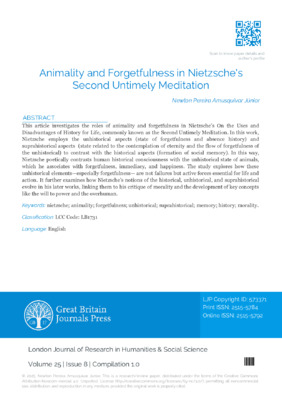
This article investigates the roles of animality and forgetfulness in Nietzsche’s On the Uses and Disadvantages of History for Life, commonly known as the Second Untimely Meditation. Nietzsche poetically contrasts human historical consciousness with the unhistorical state of animals, which he associates with forgetfulness, immediacy, and happiness. The study explores how these unhistorical elements—especially forgetfulness—are not failures but active forces essential for life and action. It further examines how Nietzsche’s notions of the historical, unhistorical, and suprahistorical evolve in his later works, linking them to his critique of morality and the development of key concepts like the will to power and the overhuman.
References
Daniela Bini (1997) Giacomo Leopardi's Ultrafilosofia. 74(1).
Otto Friedrich Bollnow (1997) Nietzsche und Leopardi. 74(1), 52-66.
Thomas Brojer (2004) Nietzsche's View of the Value of Historical Studies and Methods. 65(2).
Marco Brusotti (1997) Figure dela caducità. Nietzsche e Leopardi.
James Conant (2001) Nietzsche’s Perfectionism.
D. Conway (1997) Nietzsche & the Political.
Martin Heidegger (1996) Being and Time.
Martin Heidegger (1992) The Concept of Time.
Martin Heidegger (2003) Zur Auslegung von Nietzsche II. Unzeitgemässer Betrachtung: 'Vom Nutzen und Nachteil der Historie für das Leben'.
Curt Paul Janz (1978) Friedrich Nietzsche: Biographie.
Anthony Jensen (2016) An Interpretation of Nietzsche's On the Uses and Disadvantage of History for Life.
Vanessa Lemm (2010) History, Life and Justice in Friedrich Nietzsche's Vom Nutzen und Nachteil der Historie für das Leben. 10(3), 167-188.
Vanessa Lemm (2009) Nietzsche's animal philosophy: culture, politics, and the Animality of the human being.
Vanessa Lemm (2004) The overhuman animal.
Karl Löwith (1997) Nietzsche's Philosophy of the Eternal Recurrence of the same..
W. Müller-Lauter (1999) Nietzsche: His Philosophy of Contradictions and the Contradictions of His Philosophy.
Eduardo NASSER (2017) Transfigurações do passado: aspectos do problema do tempo na segunda Consideração extemporânea. 38(2), 57-95.
Friedrich NIETZSCHE, Walter Kaufmann (1966) Beyond Good and Evil: Prelude to a Philosophy of the Future.
Friedrich NIETZSCHE, Douglas Smith (2000) The Birth of Tragedy.
Friedrich NIETZSCHE, Duncan Lange (2007) Ecce Homo: How to Become What You Are.
Friedrich NIETZSCHE, R. J. Hollingdale (2005) Human, All Too Human.
Friedrich NIETZSCHE, Carol Dithe (2008) On the Genealogy of Morals.
Friedrich NIETZSCHE, Graham Parkes (2005) Thus Spoke Zarathustra: A Book for Everyone and Nobody.
Friedrich NIETZSCHE, Josefine Nauckhoff (2007) The Gay Science.
Friedrich NIETZSCHE, R. J. Hollingdale (2003) Twilight of the Idols and The Anti-Christ.
Friedrich NIETZSCHE, R. J. Hollingdale (2007) Untimely Meditations.
Jörg SALAQUARDA (1984) Studien zur Zweiten Unzeitgemässen Betrachtung. 13.
A. SCHOPENHAUER, E. F. J. Payne (2000) Parerga and Paralipomena: Short Philosophical Essays. 2.
A. SCHOPENHAUER, E. F. J. Payne (1966) The World as Will and Representation.
Downloads
Published
Issue
Section
License
Copyright (c) 2025 Authors and Global Journals Private Limited

This work is licensed under a Creative Commons Attribution 4.0 International License.