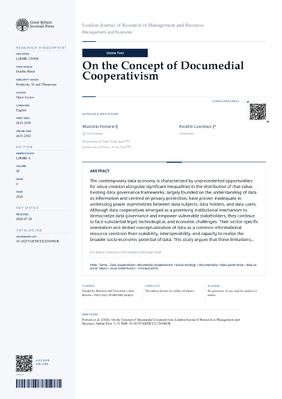
On the Concept of Documedial Cooperativism
DOI:
https://doi.org/10.34257/LJRMB229498UKKeywords:
data as social object, Data cooperatives, data governance, documedial cooperativism, documentality, interoperability., social ontology, value redistributionAbstract
The contemporary data economy is characterized by unprecedented opportunities for value creation alongside significant inequalities in the distribution of that value. Existing data governance frameworks, largely founded on the understanding of data as information and centred on privacy protection, have proven inadequate in addressing power asymmetries between data subjects, data holders, and data users. Although data cooperatives emerged as a promising institutional mechanism to democratize data governance and empower vulnerable stakeholders, they continue to face substantial legal, technological, and economic challenges. Their sector-specific orientation and limited conceptualization of data as a common informational resource constrain their scalability, interoperability, and capacity to realize the broader socio-economic potential of data.
This study argues that these limitations stem from a deeper ontological issue: the prevailing understanding of data itself. By drawing on the theory of documentality, it proposes a reconceptualization of data as a social object or documedial resource whose value is jointly constituted through the interactions of multiple stakeholders. Such an understanding provides a stronger normative and theoretical foundation for cooperative governance. Documedial cooperativism recognizes both the informative and performative dimensions of data and consequently places social sustainability, fair value redistribution, and inclusive participation at the centre of data governance.
By establishing a common conceptual framework across sectors and jurisdictions, documedial cooperativism offers greater potential for interoperability, scalability, and equitable economic participation. It reconciles the economic and social value of data, legitimizes broader collaborative uses of datasets, and provides a basis for fair remuneration of all contributors. Ultimately, the documedial approach represents a significant advancement in cooperative data governance, offering a more just, sustainable, and socially responsive framework for governing data in the digital age.
References
I. Arrieta-Ibarra, L. Goff, D. Jiménez-Hernández, J. Lanier, E. G. Weyl (2018) Should we treat data as labor? Moving beyond “free.”. 108, 38–42.
E. Bietti, A. Etxeberria, M. Mannan, J. Wong (2021) Data cooperatives in Europe: A legal and empirical investigation.
D. Boyd, K. Crawford (2012) Critical questions for big data. 15(5), 662–679. https://doi.org/10.1080/1369118X.2012.678878
M. M. Bühler, I. Calzada, I. Cane, T. Jelinek, A. Kapoor, M. Mannan, S. Mehta, M. Micheli, V. Mookerje, K. Nübel, A. Pentland, T. Scholz, D. Siddarth, J. Tait, B. Vaitla, J. Zhu (2023) Data cooperatives as catalysts for collaboration, data sharing, and the (trans)formation of the digital commons. https://doi.org/10.2139/ssrn.4413371
M. M. Bühler, I. Calzada, I. Cane, T. Jelinek, A. Kapoor, M. Mannan, S. Mehta, M. Micheli, V. Mookerje, K. Nübel, A. Pentland, T. Scholz, D. Siddarth, J. Tait, B. Vaitla, J. Zhu (2023) Unlocking the power of digital commons: Data cooperatives as a pathway for data sovereign, innovative and equitable digital communities. 3(3), 146–171.
S. Calzati, B. van Loenen (2025) Beyond federated data: A data commoning proposition for the EU’s citizen-centric digital strategy. 40, 945–957. https://doi.org/10.1007/s00146-023-01743-9
G. Carovano, M. Finck (2023) Regulating data intermediaries: The impact of the Data Governance Act on the EU’s data economy. 50, 105830. https://doi.org/10.1016/j.clsr.2023.105830
A. D. Chandler (1984) The emergence of managerial capitalism. 58(4), 473–503.
G. Cheney, M. Noyes, E. Do, M. Vieta, J. Azkarraga, C. Michel (2023) Cooperatives at work. https://doi.org/10.1108/9781838678258
M. Eben, Y. Zhu (2023) Big Tech and dominance: An overview of EU and national case law. (Special Issue: Big Tech & Dominance), 115917. https://www.concurrences.com/en/bulletin/special-issues/big-tech-dominance/big-tech-and-dominance-an-overview-of-eu-and-national-case-law
M. Ferraris (2022) Doc-humanity.
M. Ferraris (2024) Webfare: A manifesto for digital well-being.
M. Ferraris (2025) Comunismo digitale: Una proposta politica.
A. Fink (2024) Data cooperative. 13(2). https://doi.org/10.14763/2024.2.1752
L. Floridi (2011) The philosophy of information. https://doi.org/10.1093/acprof:oso/9780199232383.001.0001
S. Girish, M. Avery (2022) Data cooperative: Enabling meaningful collective negotiation of data rights for communities. https://doi.org/10.2139/ssrn.4414473
G. Grenersen, K. Kermi, S. Nilsen (2016) Landscapes as documents: The relationship between traditional Sámi terminology and the concepts of document and documentation. 72(6), 1181–1196.
E. Hafen (2019) Personal data cooperatives: A new data governance framework for data donations and precision health. 137. https://doi.org/10.1007/978-3-030-04363-6_9
P. Kalmi (2007) The disappearance of cooperatives from economics textbooks. 31(4), 625–647.
R. Kitchin (2014) Big data, new epistemologies and paradigm shifts. 1(1), 1–12. https://doi.org/10.1177/2053951714528481
O. Kuznetsova, M. Parker, A. Kuznetsov (2026) Cooperatives and business schools: Why the disconnect?. 57(1). https://doi.org/10.1177/13505076251320889
F. Mendonça, N. Abdennadher, G. Di Marzo (2025) Data cooperatives: Democratic models for ethical data stewardship. https://arxiv.org/abs/2504.10058
S. Mehta, M. Dawande, L. Mu (2022) The key to designing sustainable data cooperatives. https://www.weforum.org/stories/all/the-key-to-designing-sustainable-data-cooperatives/
M. Micheli, E. Farrell, B. Carballa-Smichowski, M. Posada-Sánchez, S. Signorelli, M. Vespe (2023) Mapping the landscape of data intermediaries: Emerging models for more inclusive data governance. https://doi.org/10.2760/261724
J. Mitchell, D. Ker, M. Lesher (2021) Measuring the economic value of data. 20. https://doi.org/10.1787/f46b3691-en
A. Pentland, T. Hardjono, J. Penn, C. Colclough (2019) Data cooperatives: Digital empowerment of citizens and workers. https://ide.mit.edu/sites/default/files/publications/Data-Cooperatives-final.pdf
D. Petreski, O. Marjanovic, M. Cheong (2025) What makes and breaks data cooperatives? A multi-case study of barriers and enablers. 1–17. https://aisel.aisnet.org/pacis2025/dig_plat/di/6
(2023) The reality of the social world: Medieval, early modern, and contemporary perspectives on social ontology.
C. Ratner (2015) Neoliberal co-optation of leading co-op organizations, and a socialist counter-politics of cooperation. 66(9). https://monthlyreview.org/2015/02/01
A. Rouvroy, B. Stiegler (2016) The digital regime of truth: From the algorithmic governmentality to a new rule of law. (3), 6–29. https://ladeleuziana.org/wp-content/uploads/2016/11/Rouvroy-Stiegler_eng.pdf
D. Sacchetto, M. Semenzin (2015) Workers’ cooperatives in Italy. 135–155.
J. Sadowski (2019) When data is capital: Datafication, accumulation, and extraction. 6(1). https://doi.org/10.1177/2053951718820549
M. Sandoval (2020) Entrepreneurial activism? Platform cooperativism between subversion and co-optation. 46(6), 801–817.
T. Scholz (2016) Platform cooperativism: Challenging the corporate sharing economy.
J. R. Searle (1995) The construction of social reality.
L. S. Shapley (1951) Notes on the N-person game—II: The value of an N-person game.
J.-P. Soininen, C. Fernández Sánchez, S. Modafferi, S. Campbell, N. Tomas, E. Salant, C. Manara, J. Kalaoja, S. K. Datta (2026) Interoperability architecture for data spaces. 66, 112678. https://doi.org/10.1016/j.dib.2026.112678
C. Stach (2023) Data is the new oil—Sort of: A view on why this comparison is misleading and its implications for modern data administration. 15(2), 71. https://doi.org/10.3390/fi15020071
A. S. Tanwar, N. Evangelatos, J. Venne, L. A. Ogilvie, K. Satyamoorthy, A. Brand (2021) Global open health data cooperatives cloud in an era of COVID-19 and planetary health. 25(3), 169–175. https://doi.org/10.1089/omi.2020.0134
A. Tarkowski, Z. Warso (2023) AI_commons: Filling the governance vacuum related to the use of information commons for AI training. https://openfuture.eu/wp-content/uploads/2023/01/ai-commons-report.pdf
United Nations Conference on Trade and Development (2021) Digital economy report 2021: Cross-border data flows and development: For whom the data flows. https://unctad.org/system/files/official-document/der2021_en.pdf
J. van Dijck (2024) Governing platforms and societies. 1. https://doi.org/10.1177/29768624241255922
S. Viljoen (2021) A relational theory of data governance. 131, 573–654.
S. Zuboff (2019) The age of surveillance capitalism: The fight for a human future at the new frontier of power.
J. O. Zygmuntowski (2023) Data governance in a trilemma: A qualitative analysis of rights, values, and goals in building data commons. 2, 30. https://doi.org/10.1007/s44206-023-00058-y
Downloads
Published
Issue
Section
License
Copyright (c) 2026 Authors and Global Journals Private Limited

This work is licensed under a Creative Commons Attribution 4.0 International License.